
 English
 Deutsch
 한국어
한국어
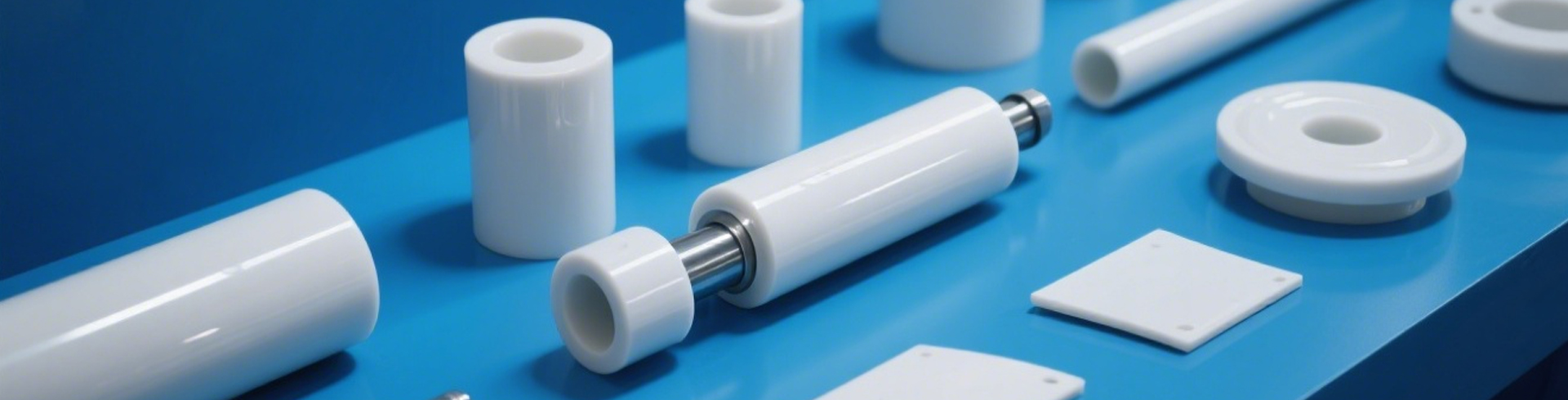
| Pressureless Sintering Silicon Carbide (SSiC)Ceramic Properties | ||
| Item | Unit | Typical Values |
| Physical Properties | ||
| Color | Grey Black | |
| Density | g/cm3 | 3.10-3.15 |
| Silicon Carbide Content | % | ≥99 |
| Porosity | % | <0.1 |
| Poisson's ratio | 0.16 | |
| Mechanical Properties | ||
| Hardness | HRA | ≥92 |
| Flexural Strength | Mpa | ≥400 |
| Compressive Strength(HV0.5) | Mpa | ≥2600 |
| Modulus of Elasticity | Mpa | 410 |
| Thermal Properties | ||
| Maximum Working Temperature | °C | 1600 |
| Thermal Conductivity(indoor temperature) | W/m.K | 120 |
| Thermal Expansion Coefficient | 10-6/°C | 4 |
| Electronic Properties | ||
| Volume Resistivity | Ω.cm | 103-104 |
Features
Silicon Carbide (SiC) is a high-performance ceramic material with excellent high-temperature stability, electrical conductivity and corrosion
resistance.
1. Excellent strength at high temperatures
Silicon carbide retains its strength at extremely high temperatures, making it an ideal choice for many high-temperature applications.
High temperature industrial applications: Silicon carbide is widely used in high temperature industrial fields, such as furnaces, heat treatment
equipment and high temperature reactors. Its high temperature strength and stability enable it to maintain structural integrity at temperatures up
to 1400°C or even higher, and withstand extreme thermal stress and pressure.
2. Excellent performance of thermal conductivity and electrical semiconductor
Silicon carbide has extremely high thermal conductivity and electrical semiconductor properties, which makes it widely used in the electronics
industry and high-power electrical appliances.
Thermal conductivity: Silicon carbide is an excellent thermal conductor, with a higher thermal conductivity than many metals. This makes it very
useful in applications that require efficient heat dissipation, such as heat dissipation substrates for electronic devices and electronic packaging
materials.
Electrical semiconductor properties: Silicon carbide has semiconductor properties, with high electron mobility and low resistivity, making it
perform well in power electronic devices. For example, silicon carbide power devices have lower losses and higher efficiency in high temperature
and high frequency environments.
3. High hardness and corrosion resistance
Silicon carbide has excellent chemical and physical stability, and exhibits high hardness and corrosion resistance.
High hardness: Silicon carbide has a hardness close to that of diamond, which makes it extremely resistant to wear and scratching. This makes it
very useful in manufacturing wear-resistant parts and cutting tools.
Corrosion resistance: Due to its chemical stability, silicon carbide has good corrosion resistance to many chemicals, allowing it to be used stably
and for a long time in chemical and liquid handling equipment.
The versatility and excellent performance of silicon carbide make it widely used in many fields, including high-temperature industry, electronic
devices, mechanical engineering and chemical industry. Its high-temperature stability, thermal conductivity, semiconductor properties, high
hardness and corrosion resistance make it a very important engineering material, driving technological development and innovation in various fields.


