
 English
 Deutsch
 한국어
한국어 Français
 Português
 Español
 Русский



Design Features
1. Advantages of laser cutting technology – Precision down to the smallest details
We employ a high-energy-density, low-thermal-affect laser system, which enables extremely high processing precision while
ensuring the structural integrity of the material.
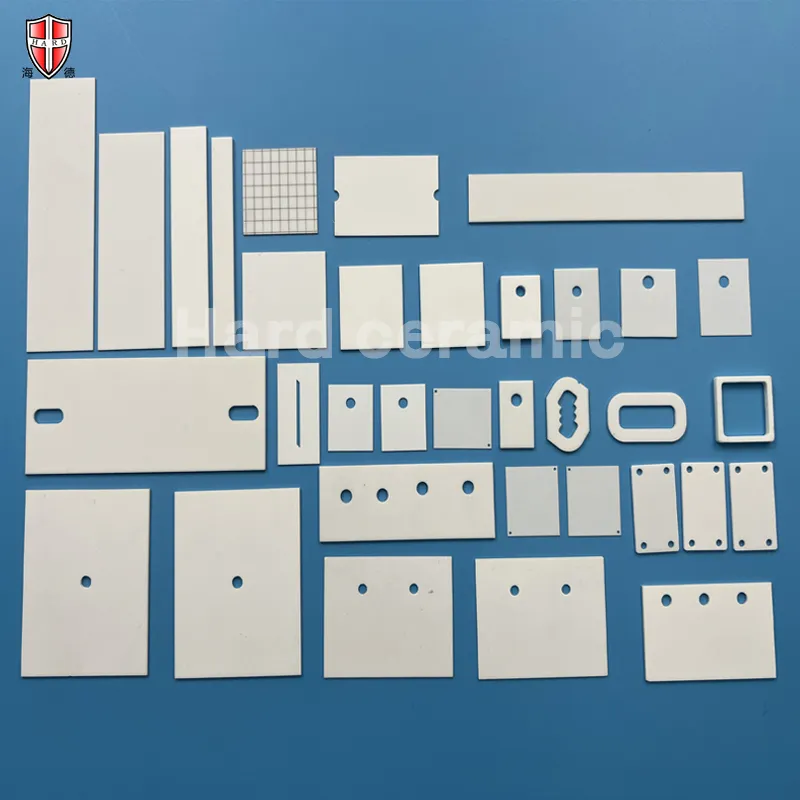
Cutting thickness range: 0.1–9 mm. Suitable for machining all thicknesses from ultra-thin ceramic substrates to high-strength
structural components.
Cutting accuracy:
±0.02 mm. Helps microelectronics and high-precision packaging achieve tighter structural tolerances.
Minimum hole diameter:
0.04 mm. Enables complex processes such as micro-hole arrays, micro-vias, and microstructure slotting.
Cutting line width:
0.04 mm. Extremely narrow kerf reduces material loss, resulting in clean, chipped edges.
Laser micromachining can achieve complex contours that traditional cutting tools cannot process, and is suitable for
high-frequency ceramic circuits, sensor substrates, precision microstructure parts, etc.
2. Precision grinding and polishing – achieving mirror-like surface smoothness
After laser cutting, Haide Ceramics further employs high-precision double-sided grinding and polishing processes to achieve:
Surface roughness:
Ra ≤ 0.1 μm. Meets the requirements of microcircuit thick-film printing, thin-film metallization, and chip mounting processes.
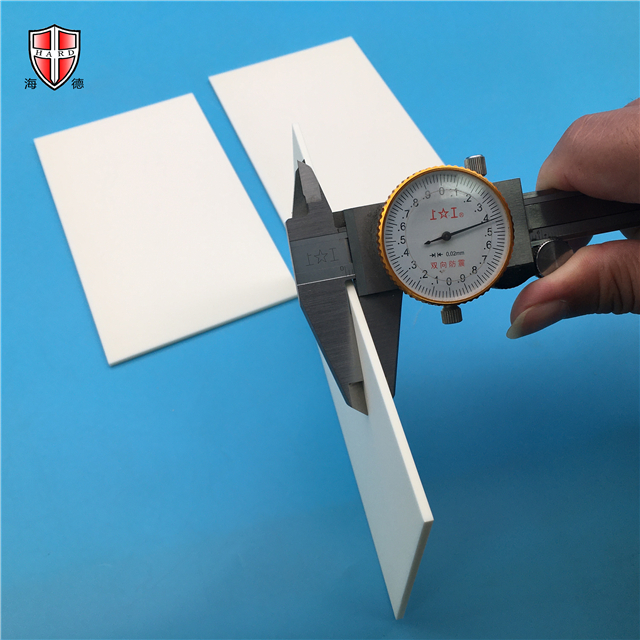
Thickness tolerance:
±0.02 mm. High batch consistency, suitable for automated mounting and precision stacking structures.
The high flatness makes the ceramic substrate more stable and reliable in packaging, heat dissipation and circuit wiring.
3. Excellent electrical insulation and dielectric properties – suitable for high-frequency and high-voltage applications.
Alumina ceramics possess advantages such as strong insulation and high dielectric stability, making them suitable for high-frequency,
high-voltage, and precision control systems.
Volume resistivity: >10¹⁴ Ω·cm (500℃)
Dielectric constant: 9–10 (1 MHz)
Breakdown field strength: ≥25 kV/mm
Whether used in RF antennas, power electronic modules, or high-voltage ignition devices, it can provide reliable dielectric
isolation and signal stability.
4. High thermal conductivity and thermal stability – providing reliable heat dissipation for power devices.
Thermal conductivity: 25 W/(m·K) (96% alumina)
Coefficient of thermal expansion: 6.5 × 10⁻⁶/℃ (close to silicon)
Maximum operating temperature: 1600℃
Ceramic substrates maintain thermal stability and dimensional consistency even in high power density or cyclic thermal
shock environments, making them a key material for IGBTs, power modules, and LED packaging.
5. Enhanced mechanical properties – Stable load-bearing system
Alumina ceramics combine high strength and lightweight:
Flexural strength ≥ 300 MPa
Compressive strength ≥ 2000 MPa
Vickers hardness: 1600 HV
Density: 3.7 g/cm³
Suitable for high-speed impact, vibration environment, and high load support scenarios, such as precision support structures
and sealing base plates.
Application areas
1.Electronic packaging substrate
Power module insulating substrate (IGBT, MOSFET)
Multilayer ceramic circuit board (LTCC/HTCC)
RF microwave device carrier
2.Semiconductor manufacturing
Wafer processing support ring
Plasma etching fixture
High-temperature process tray
3.New energy field
Fuel cell bipolar plate
Lithium-ion battery separator coating substrate
Photovoltaic inverter heat dissipation substrate
4.Special sensors
High-temperature pressure sensor substrate
MEMS device support platform
Optical detection reflective substrate
As a professional ceramic component manufacturer, we offer customized alumina substrate services ranging from 95% to 99.9% purity,
supporting substrate production up to 600×600mm in size. We can also perform metallization treatments (copper plating, gold plating,
molybdenum-manganese layers, etc.) upon request. Through optimized material formulations and innovative structural designs, our
ceramic substrate solutions have been successfully applied in cutting-edge fields such as 5G base station power amplifiers, electric
vehicle electronic control systems, and satellite payloads, continuously providing fundamental material support for our
customers' equipment miniaturization, high-power operation, and reliable high-temperature operation.


